What Is AI Slop and How Does It Affect Kids’ Critical Thinking?
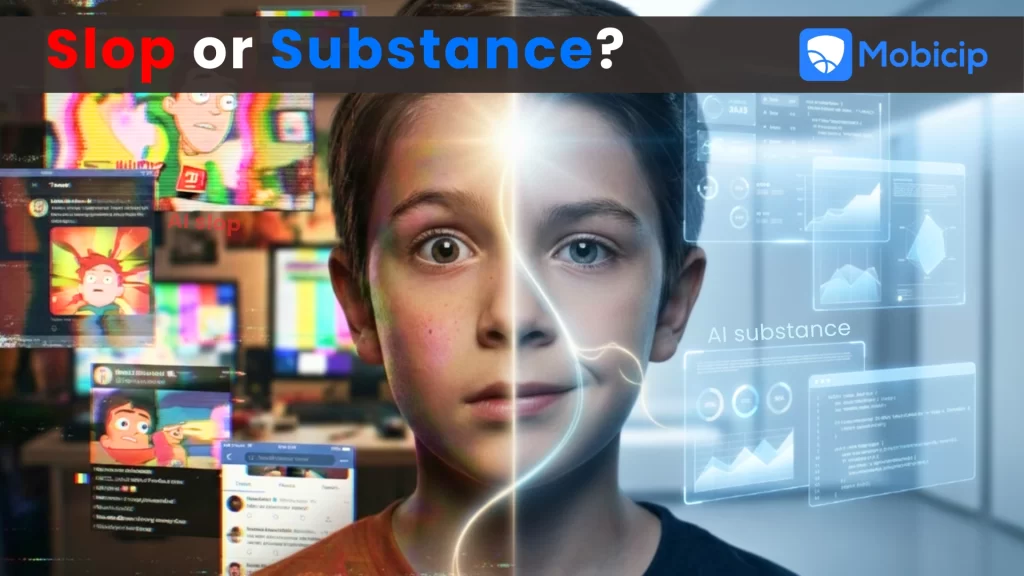
“Slop” was named the Word of the Year by Merriam-Webster, and it’s an uncomfortably accurate way to describe a growing part of our digital life. AI slop refers to content that is quickly produced, repetitive, shallow, and designed more to fill feeds than to inform or challenge. It often looks polished and confident but lacks depth, accuracy, or originality.
AI slop shows up in short videos, social media posts, search results, homework answers, and even news-like articles. Algorithms reward speed and volume, making it harder to tell the difference between thoughtful information and content that merely sounds right.
This article explores what AI slop is, why kids are particularly vulnerable to it, and how it can quietly affect their critical thinking skills. It also examines how parental guidance and tools like Mobicip can help families filter out low-quality content, monitor digital habits, and support more intentional, thoughtful online learning.

Examples of AI Slop
AI slop often looks helpful on the surface, which makes it especially hard for kids to recognise. It appears in familiar formats they already trust, but delivers information without depth or reasoning.
- Short-form explainer videos. For example, a 30-second video claiming to explain climate change using catchy visuals and confident narration, but reducing a complex issue to a single cause or misleading claims.
- Repetitive articles and posts. For example, multiple blog posts or social media threads with different headlines but nearly identical paragraphs explaining “study hacks” or “exam tips,” offering no real guidance beyond generic advice.
- AI-generated homework help. For example, an essay or math explanation produced by AI that is grammatically perfect but so vague that the child cannot explain how they arrived at the answer when asked.
- Quick summaries or study guides. For example, a one-page summary of a history chapter that lists events but removes causes, consequences, and connections.
- Engagement-driven content. For example, posts that exaggerate facts or use emotional language like “You won’t believe this” to keep kids scrolling rather than thinking.
When children repeatedly consume this kind of content, it can quietly replace curiosity with convenience.
Why Kids Are Especially Vulnerable to AI Slop
Kids are especially vulnerable to AI slop not because they are careless or uninformed, but because today’s digital platforms actively encourage it. Algorithms shape much of what children see, prioritising engagement and volume over quality and pushing low-effort, AI-generated content alongside credible sources.
Several factors make it harder for kids to spot the difference:
- Algorithm-driven feeds reward speed, repetition, and emotional appeal, not accuracy or depth.
- Short-form, fast-scroll content leaves little time to pause, question, or reflect on what they’re consuming.
- Confident-sounding language makes it difficult to distinguish between content that sounds right and content that is right.
- Seamless blending of AI slop with legitimate content means low-quality material often looks just as polished as trustworthy information.
Together, these conditions create an environment where shallow or misleading content can slip through unnoticed. Without guidance, kids may accept what they see at face value, mistaking fluency and confidence for real understanding.
How AI Slop Affects Critical Thinking
AI slop doesn’t just affect what kids consume, it shapes how they think, process information, and approach learning. Over time, repeated exposure to shallow, fast-produced content can quietly weaken key critical thinking skills.
Shallow understanding
When children rely on AI-generated content that prioritises speed over substance, learning can become superficial. They may receive answers without the reasoning behind them, making it harder to grasp underlying concepts. As a result, curiosity fades; kids ask fewer “why” and “how” questions because the content rarely invites deeper exploration.
Reduced attention and evaluation
AI slop encourages skimming rather than careful reading. Information is absorbed in quick bursts, often without reflection. This makes it easier for children to accept content at face value, without checking sources, questioning accuracy, or thinking critically about what they’ve read or watched.
Over-reliance on AI outputs
When AI becomes a shortcut rather than a support tool, original thinking suffers. Instead of working through problems or forming their own ideas, kids may depend on AI-generated answers. Over time, this reliance can weaken problem-solving skills and reduce confidence in their own ability to think independently.
AI Slop vs Helpful AI: The Key Difference
Not all AI content is harmful, and it’s important to avoid framing AI itself as the problem. The problem arises when AI replaces thinking instead of supporting it. AI slop delivers quick, confident answers without explanation, context, or depth. It removes the effort required to question, analyze, or connect ideas, turning learning into passive consumption rather than active engagement.
One way to tell the difference is to look for quality signals. Some common signs include:
- Homework that sounds unusually polished but falls apart when the child is asked to explain the ideas behind it
- Repetitive phrasing or vague explanations that rely on general statements instead of clear reasoning
- Difficulty explaining answers in their own words, even for topics they’ve supposedly just studied
- Overconfidence paired with shallow knowledge, where children are sure they’re correct but can’t answer follow-up questions
Helpful AI content often cites sources, acknowledges uncertainty, and offers nuance rather than making absolute claims. It explains why an answer works, not just what the answer is. AI slop, on the other hand, tends to sound confident, polished, and complete, while offering little context or opportunity for deeper thinking.
Helping Kids Build Critical Thinking in the Age of AI
The goal isn’t to shield children from AI, but to equip them with skills to question, evaluate, and think independently. Clear, practical guidance makes a real difference.
Focus on these action areas:
- Teach kids to ask “Where did this come from?” Encourage them to look for sources, authors, or references. If an answer can’t be traced, it shouldn’t be trusted blindly.
- Ask children to check the same information in two or three places. Differences often reveal gaps, bias, or oversimplification.
- Set aside time to read or watch content fully, rather than skimming. Follow up with simple questions like, “What surprised you?” or “What didn’t make sense?”
- When AI tools are used for homework or research, keep them visible. Sit together, review outputs, and discuss whether the answers actually hold up.
These habits help children move from passive consumption to active thinking, an essential skill in an AI-saturated world.
The Role of Mobicip and Guidance Tools
As AI-generated content becomes harder to distinguish from reliable information, specific parental control features can help families guide digital use more intentionally. Mobicip is designed to support parents in this role, not by policing behaviour, but by providing structure and visibility.
Mobicip supports families through features designed to manage and structure screen time effectively:
- Daily screen time limits let parents set maximum device use per day, preventing endless scrolling through shallow or repetitive AI-generated content
- Scheduled device access automatically blocks devices during homework, meals, or bedtime, reinforcing healthy routines without constant reminders
- App-specific restrictions focus screen time on productive or educational apps while limiting time on platforms prone to AI slop
- Usage reports show exactly how time is spent, helping parents spot patterns, identify overuse, and discuss better habits with children

By making content patterns visible and manageable, Mobicip helps parents create space for meaningful conversations about what kids are seeing online and how to think critically about it, not just consume it passively.
Take Away: From Slop to Substance
AI is here to stay, and so is the challenge of AI slop. The goal isn’t to eliminate screens or AI, but to help children navigate content thoughtfully, turning what could be shallow consumption into opportunities for learning and reflection.
By teaching kids to question sources, compare information, and slow down their digital habits, parents can transform screen time from passive scrolling into active thinking. Tools like Mobicip make this easier by providing structure, insight, and age-appropriate controls, so guidance is consistent without being confrontational.
With intentional habits, conversations about content, and smart use of technology, families can move from slop to substance. Children learn not just to consume, but to evaluate, reason, and create, developing critical thinking skills that will serve them well in school, in life, and in a world increasingly shaped by AI.