
What Is Meta’s AI Topics Insights Feature and How Does It Help Parents Understand Teen AI Use?
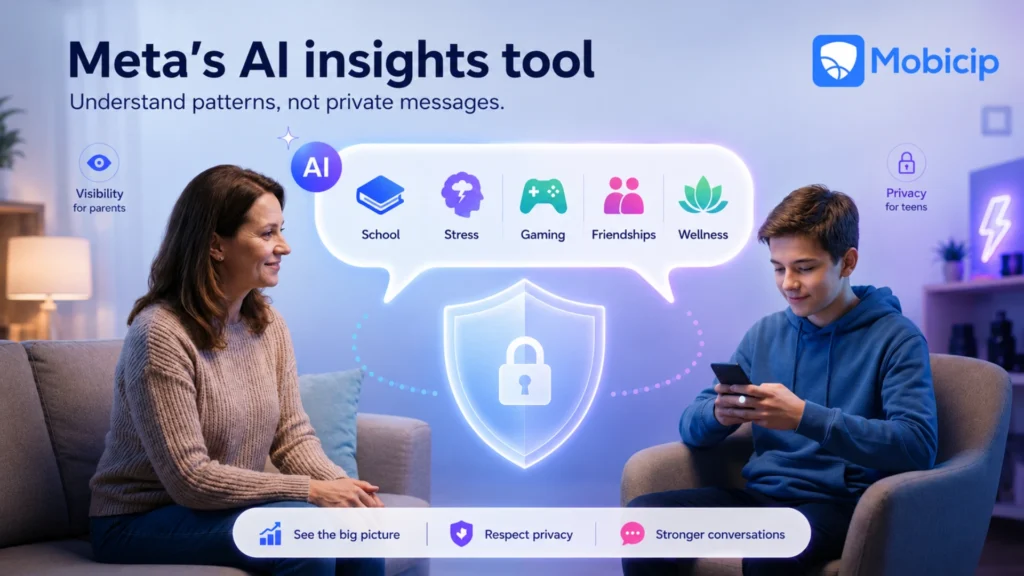
Meta’s AI Topics Insights feature lets parents see the topics their teens are asking Meta AI about across Instagram, Facebook, and Messenger. Introduced by Meta Platforms, this tool provides a high-level view through an “Insights” tab, where parents can track categories such as school, health, entertainment, and more—without accessing full conversations.
This update is timely and relevant because AI is rapidly becoming a go-to resource for teens, not just for homework, but for advice, decision-making, and even emotional support. As AI begins to play a more personal role in their lives, parents need better awareness of how their children are interacting with these systems, while still respecting their independence.
In this post, we break down what this feature offers, where its limits lie, and what it signals about the evolving digital landscape. We also explore how tools like Mobicip can complement such updates by helping parents guide their children’s online experiences in a more balanced and proactive way.
What Is Meta’s AI Topics Insights Feature?
Meta’s new AI supervision feature is a tool that helps parents understand how their teens are using AI across social media. In simple terms, it shows the topics teens are asking AI about, rather than the exact conversations. This gives parents a general sense of their child’s interests and concerns without directly reading private chats.
This feature is part of the supervision system introduced by Meta Platforms and appears as an “Insights” tab within Instagram, Facebook, and Messenger. It aggregates a teen’s interactions with Meta AI over the past seven days and categorizes them into themes such as education, health, entertainment, and lifestyle. Parents can tap into each category to get a slightly more detailed breakdown.
What makes this different from earlier parental controls is its focus on AI interactions rather than screen time or app usage. Instead of tracking how long teens are online, it offers context about what they are engaging with, marking a shift from quantity-based monitoring to insight-driven awareness.
How Meta’s AI Topics Insights Tool Works
At a basic level, the AI Topics Insights tool organizes a teen’s interactions with Meta AI into clear, easy-to-understand topic categories. Instead of showing exact questions or conversations, it provides a summarized view of what a teen has been asking about over time.
The system groups queries into broad themes such as school, entertainment, health, and lifestyle. These appear in an “Insights” tab within the supervision dashboard across Instagram, Facebook, and Messenger. Parents can tap on a topic to explore subcategories—for example, lifestyle may include fashion, food, and holidays, while health and well-being may include fitness, physical and mental health.
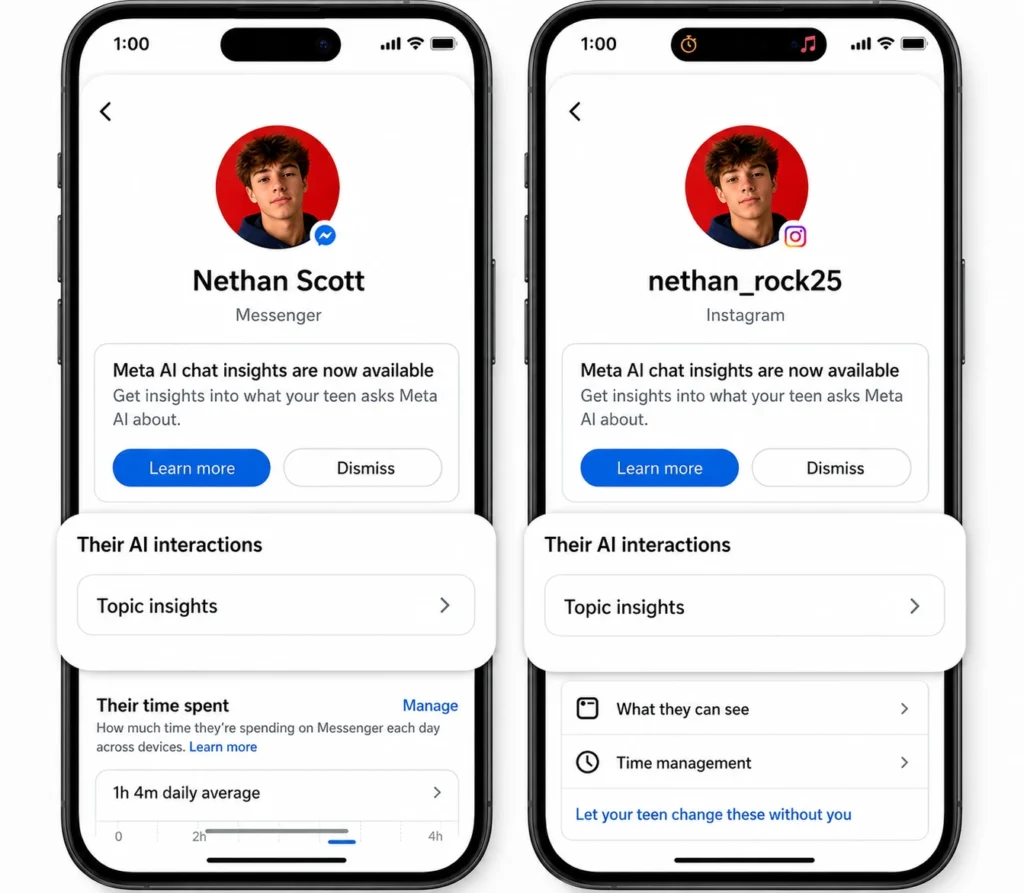
For instance, questions about exams or homework may fall under education, while queries about stress may appear under health. The focus is on patterns, not specifics, helping preserve privacy while still offering useful context.
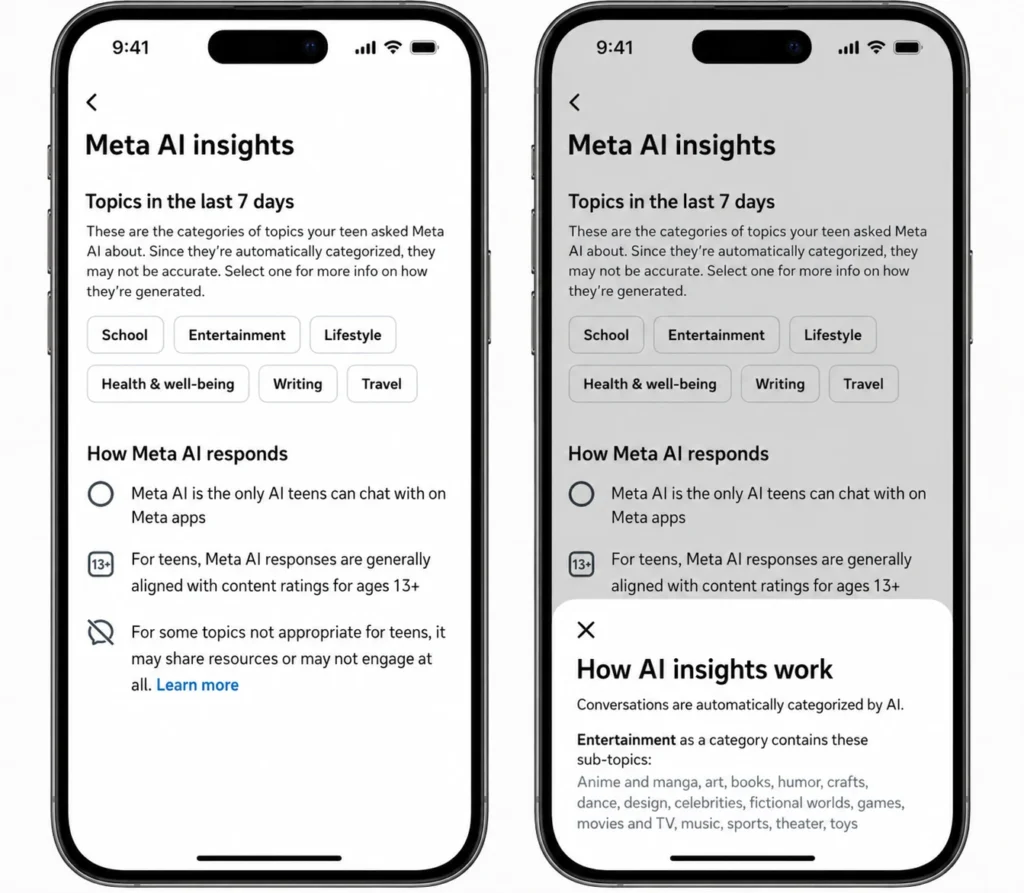
This feature also builds on existing safeguards designed to limit age-inappropriate AI responses and redirect sensitive queries to trusted resources. Even if the AI does not respond, the topic may still appear. According to Meta, future updates may include alerts for more serious concerns, such as self-harm, showing that this is part of a broader, evolving safety approach.
Why Meta’s AI Topics Insights Matter for Parents
As AI becomes a regular part of teens’ daily lives, it is no longer just a tool for quick answers—it is shaping how they think, learn, and seek support. This shift makes it important for parents to understand not just how often their children are online, but what they are turning to AI for. Features like this offer a new layer of awareness, helping parents stay connected to their child’s digital experiences without being overly intrusive.
- AI is becoming a trusted source: Many teens use AI for advice, problem-solving, and even emotional support.
- Early signals of concern: Topic trends can hint at stress, anxiety, or other challenges before they are openly expressed.
- A shift from screen time to context: This moves parental awareness beyond usage limits to understanding content and intent.
- Encourages meaningful conversations: Insights can help parents start relevant, timely discussions with their teens.
- Balances privacy and oversight: High-level summaries allow awareness without exposing private conversations.
- Supports safer digital habits: Combined with guidance, it helps teens use AI more responsibly and critically.
What Are the Benefits and Limitations of Meta’s AI Topics Insights Tool?
Meta’s AI Topics Insights tool provides useful visibility into teen AI activity while respecting privacy by avoiding full conversation access. However, it also has limitations, including lack of detailed context, delayed insights, and restricted coverage outside Meta’s ecosystem, meaning it cannot replace broader digital supervision.
Like most parental control updates, this feature offers meaningful advantages—but also comes with important limitations. Understanding both sides can help parents use it more effectively.
Benefits
- Provides high-level visibility: Parents can see the general topics their teens are exploring without needing access to full conversations.
- Encourages timely conversations: Topic trends can help parents identify areas of interest or concern and start relevant discussions.
- Respects teen privacy: By focusing on categories instead of exact queries, the feature avoids overly intrusive monitoring.
- Highlights patterns over time: Weekly summaries make it easier to notice shifts in behaviour or emerging concerns.
- Integrates with existing safeguards: It works alongside built-in protections that limit inappropriate AI responses.
Limitations
- Lacks detailed context: Without seeing exact questions, parents may misinterpret what a topic actually means.
- Limited to one ecosystem: It only reflects interactions within Meta apps, not across other AI platforms teens may use.
- No real-time alerts (yet): Insights are retrospective, which may delay response to immediate concerns.
- Relies on teen participation: Teens may choose other apps or accounts outside supervision.
- Not a complete solution: It provides awareness, but cannot replace active guidance, communication, or broader parental controls.
How Parents Can Talk to Teens About AI
Features like Meta’s AI insights tool can show parents what topics their teens are exploring—but they don’t explain why. That gap makes conversation essential. Instead of relying only on the insights dashboard, parents can use it as a starting point to better understand their teen’s thoughts, questions, and concerns.
- Use insights as conversation starters. If a topic like stress or school appears frequently, ask about it in a calm, curious way.
- Avoid jumping to conclusions. A topic doesn’t always reflect a problem; give teens space to explain their intent.
- Discuss how they use AI. Ask when they turn to AI instead of a person, and what they find helpful about it.
- Clarify AI’s limits. Reinforce that AI responses may not always be accurate, complete, or emotionally appropriate.
- Encourage real-world support. Remind teens that parents, teachers, or trusted adults are better sources for serious concerns.
- Keep it collaborative. Frame discussions as shared learning rather than monitoring, so teens feel supported, not watched.
How Can Mobicip Help Parents Manage Teen AI Use Across Devices?
Mobicip helps parents manage teen AI use by providing screen-time controls, app and website filtering, activity reports, and cross-platform monitoring across devices. These features support safer digital habits by helping families guide AI use beyond a single platform or application.
While features like Meta’s AI insights offer a useful glimpse into teen activity within a single platform, children today interact with AI and digital content across multiple apps and devices. This makes it important to look beyond platform-specific tools and adopt a more comprehensive approach to digital safety. Mobibicip helps parents manage their child’s overall online experience, not just one part of it.
- Cross-platform monitoring: Tracks activity across apps, browsers, and devices, not limited to a single ecosystem.
- Screen time management: Allows parents to set daily limits and create healthy usage schedules.
- App and website blocking: Filters inappropriate or unsafe content before it reaches the child.
- Usage reports and insights: Provides regular summaries to help parents understand digital habits over time.
- Customisable controls: Enables families to tailor rules based on the child’s age and needs.
- Encourages balanced use: Supports a guided approach that combines supervision with independence.
How Can Families Balance Teen Privacy and Digital Safety?
Tools like Meta’s AI insights feature and broader parental control solutions such as Mobicip aim to solve the same challenge: how to keep children safe online without undermining their sense of independence. While Meta’s feature offers topic-level visibility into AI use, tools like Mobicip provide wider oversight across apps, devices, and browsing activity. Together, they highlight an ongoing tension between safety and privacy in the digital age.
Striking the right balance is less about the tool itself and more about how it is used.
- Safety requires visibility: Insights into AI topics or overall usage patterns can help parents spot early signs of stress, risky behavior, or unsafe interactions.
- Privacy builds trust: Teens are more likely to be honest and open when they don’t feel constantly watched or judged.
- Different tools, different depths: Platform-specific features offer limited, high-level insights, while parental control tools provide broader monitoring.
- Context still matters: Data alone cannot explain intent; conversations cannot be replaced.
- Over-monitoring can backfire: Excessive tracking may lead teens to hide activity or move to unsupervised spaces.
Ultimately, the goal is not total control, but guided independence—using tools to support awareness while maintaining open communication and mutual trust.
How Mobicip Adds to Digital Protection
While Meta’s AI Topics Insights feature helps parents understand the kinds of topics teens are exploring through AI, it only covers activity within Meta’s apps. Teens, however, interact with a much wider digital world across browsers, games, social media platforms, and AI tools. This is where Mobicip can provide an additional layer of protection. By offering broader visibility and customizable parental controls across devices, Mobicip helps families create safer and more balanced digital habits beyond any single platform.
Key Features of Mobicip
- Cross-platform monitoring: Tracks activity across smartphones, tablets, and computers, not just one app ecosystem.
- Screen time management: Lets parents set daily usage limits and healthy digital schedules.
- Website and app blocking: Helps filter inappropriate, distracting, or unsafe content before children access it.
- App usage insights: Provides visibility into which apps are used most frequently and for how long.
- Safe browsing tools: Supports safer internet use through web filtering and browsing controls.
- Customizable parental controls: Allows settings to be adjusted based on the child’s age, maturity, and needs.
- Family-focused approach: Encourages guided digital independence rather than intrusive monitoring.
- Supports healthier digital habits: Helps families balance entertainment, learning, sleep, and offline activities more effectively.

Frequently Asked Questions
What is Meta’s new AI Topics Insights feature for parents?
Meta’s new feature allows parents to see the topics their teens are asking AI about across Instagram, Facebook, and Messenger. It provides a high-level overview through an Insights dashboard, without showing exact conversations.
Can parents see their teen’s exact AI chats in Meta’s new AI Topics Insights?
No, the feature does not display full conversations or exact questions. It only shows general topic categories to balance parental awareness with teen privacy.
Why are teens using AI so frequently?
Teens use AI for a range of purposes, including homework help, creative tasks, advice, and sometimes emotional support. Its accessibility and instant responses make it especially appealing.
Is Meta’s AI monitoring feature enough to keep teens safe?
Not entirely. While it provides useful insights within Meta apps, teens often use multiple platforms. A broader approach, including open conversations and tools like parental controls, is more effective.
How can parents guide safe AI use for teens?
Parents can start open conversations, explain AI’s limitations, encourage critical thinking, and set clear expectations. Using tools like Mobicip can also help create a safer and more balanced digital environment.